



21 Jul Building a Culture of Transparency: A Frontline Hospitality Pilot
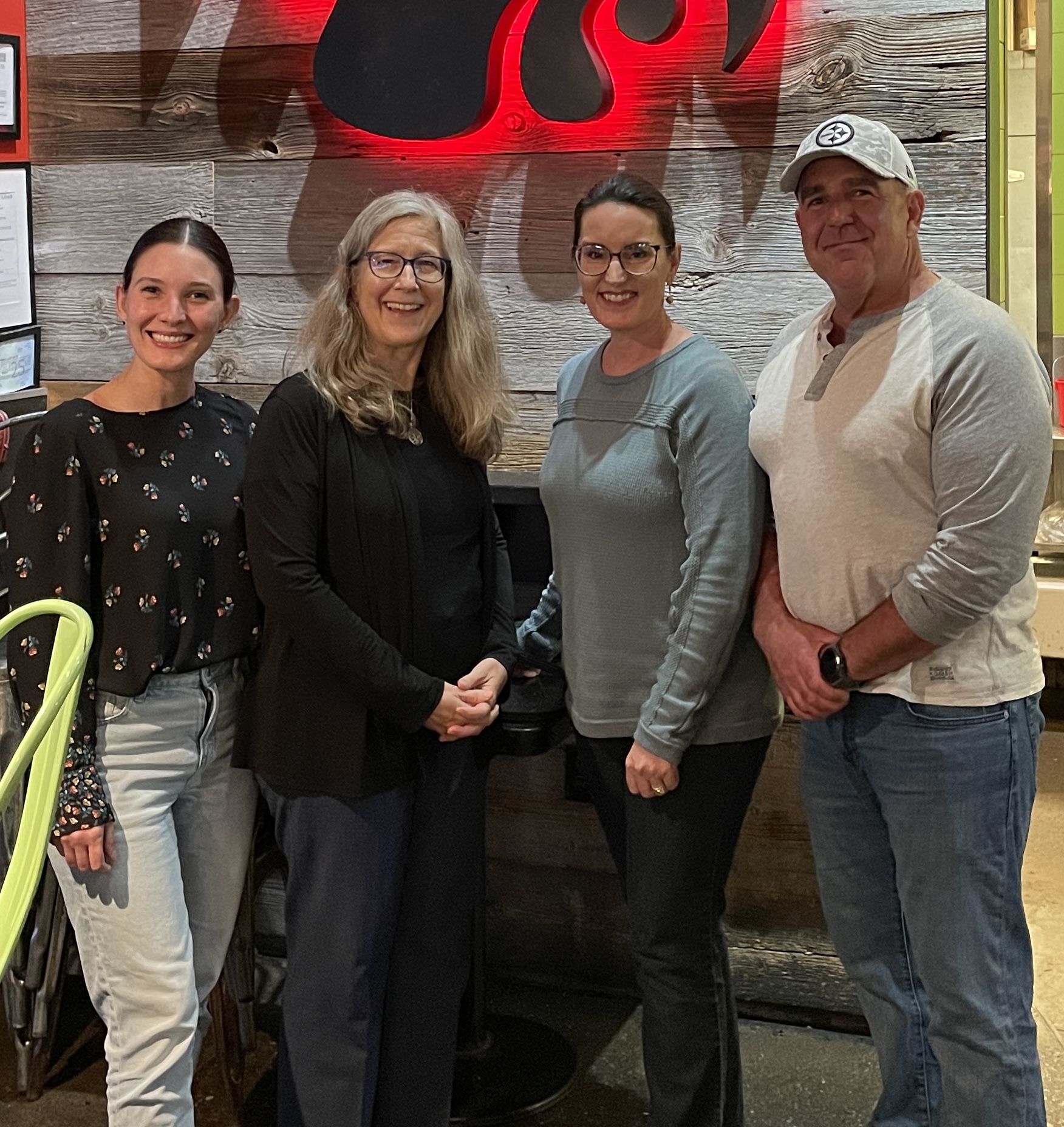
Image: Photo of Anne-Claire with Alexis Bovalino of Burgatory and Jessica and Matt Borza of Pondi’s
For the past three years, Broughton Consulting has been collaborating with Shift Work Forward and the Great Game of Business (GGOB) to pilot open book management systems at hospitality and other businesses with frontline workers. The goal is to show that coaching-based transparency models such as GGOB can offer an effective alternative to more established workforce strategies. GGOB coach Anne-Claire Broughton has worked with a number of the companies in the pilot, including Pondi’s, a 100+ year old family restaurant in Lisbon, OH, and Burgatory in Pittsburgh, a locally owned group of restaurants featuring unique craft burgers, shakes, and beverages.
This initiative is part of an exciting project led by Shift Work Forward to embed what is known as “human-centered design (HCD),” systems that give frontline workers agency over aspects of their jobs, as well as amplified voice, in both for-profit businesses such as Pondi’s and Burgatory, as well as nonprofit health-care agencies. Broughton Consulting is committed to helping to create systems that empower frontline workers so this was a very aligned project for us.
What We Did
Shift Work Forward worked with several regional workforce agencies to recruit employers to participate in this pilot, including The Fund for Our Economic Future in Northeast Ohio and Partner4Work in Pittsburgh. These agencies, along with Shift Work Forward and private foundations, provided much of the funding for the initiative. Anne-Claire Broughton coached both Pondi’s and Burgatory through putting in place the open book management system, training both management and all employees in the basics of GGOB (scoreboards, huddles, MiniGames, and the bonus plan), the specifics of how their businesses make money and generate cash, and how each person and department contributes to the bottom line. “In the GGOB system, we gamify business and we teach each person that they truly matter in making the business successful,” explains Broughton. “It’s exciting when we present the information and employees immediately have ideas for how to increase revenue and reduce waste and inefficiencies.”
Pondi’s Results
Pondi’s is a 100-year-old family restaurant in Lisbon, Ohio, run by Jessica and Matt Borza. With Anne-Claire’s assistance, they implemented weekly huddles where all staff review real financials. During the initial training, employees played a game designed to help them understand the business’s sources of revenue, its actual costs and expenses, and how their actions can positively influence financial performance.
The team also played multiple MiniGames (short continuous improvement campaigns targeting specific cost areas (e.g., cleanliness, food waste, inventory management) as well as revenue improvement (upselling). “They were my MiniGame champions,” says Anne-Claire. “They were relentless about finding areas of improvement and playing MiniGames to develop lasting habits while having fun.”
All these efforts paid off. By the end of 2024, the company went from a projected $25,000 loss to a $280,000 profit. This enabled them to pay out $77,000 in bonuses to the team – a first-ever event for most of these frontline restaurant workers. In addition, average full-time team member compensation grew 9.9% (3x the state average), while part-time workers making less than $20K saw a 13.9% earnings growth. In addition, Pondis’ retention rate is 81% vs. the restaurant industry standard of 25%. Overall, total worker gains exceeded $300,000 in just one year of playing Great Game of Business. Read the full Pondis’ case study here.
Burgatory Results
The second business in the pilot was Burgatory, a 7-location burger-and-milkshake chain in Pittsburgh with family hospitality roots. In 2019, leadership was pursuing a private equity deal for national expansion, but this was derailed by COVID. Rather than mass layoffs, leadership cut their own salaries, secured PPP loans, and used the pause to rethink the entire business.
With encouragement from Partner4Work, Burgatory fully embraced the Great Game of Business and began coaching with Anne-Claire in the fall of 2023. “We started by training the admin team that works with all the restaurants,” says Anne-Claire. “Then in the spring of 2024 we trained all 500 employees across 7 locations in three days via a traveling roadshow where the admin team took turns presenting and running the restaurants so staff was freed up for the training.”
Each location got customized scoreboards, their own critical numbers, and store-specific MiniGames. A monthly “Burgatory Cup” contest drove friendly competition around forecasting and margins. “One of the first results was that the admin team developed a common language,” says Broughton. “Rather than arguing about a menu change that would be great for customers but might be expensive, the whole team was aligned around finding solutions that tasted great and also saved money.” For example, finding a new cheese vendor that saved the company $45,000 but provided the same great flavor.
In addition, a silverware recovery MiniGame saved $26,000 and improved liquor tracking saved $6,000. One location cut their health inspection cleaning time from 3 hours to 45 minutes. Hourly staff began forecasting food costs, and employees began using the skills they had learned at Burgatory to better manage their personal finances. Read the full Burgatory case study here.
What’s Next
We are currently coaching four more businesses as part of this collaboration with Shift Work Forward, so stay tuned for more great results!